

Welcome back to the Curious About Everything Newsletter! CAE 64 is here, if you missed it. The most popular link from last month was Cailey Rizzo’s essay about Anthony Bourdain.
Personal updates on serendipity and grief
“I’ve learned over the years that there is no antidote to the profound, compounding grief of continually finding yourself on the outside of the life you thought you’d have.”
It has been a long while since I wrote something narrative, and I forgot the feral flow that comes over you when you just sit down and let all the emotions you’re feeling come out word by word.
I’ve been thinking a long while about living grief, and could not put my feelings into words until I lost my stepmom earlier this year. The contrasts between my bereavement grief and the other grief of ongoing chronic illness helped me shape what I wanted to share.
I write about losing not only Deborah but also losing years of memories when my hard drives and laptop were stolen in 2010 during a burglary. It took 15 years, but they all came back to me thanks to the kindness and grace of a stranger named Ariel, who found them at a flea market and made it his mission to return them one day.
You can read it all here: The mountains I lost, the memories I found.
Featured art for CAE 65
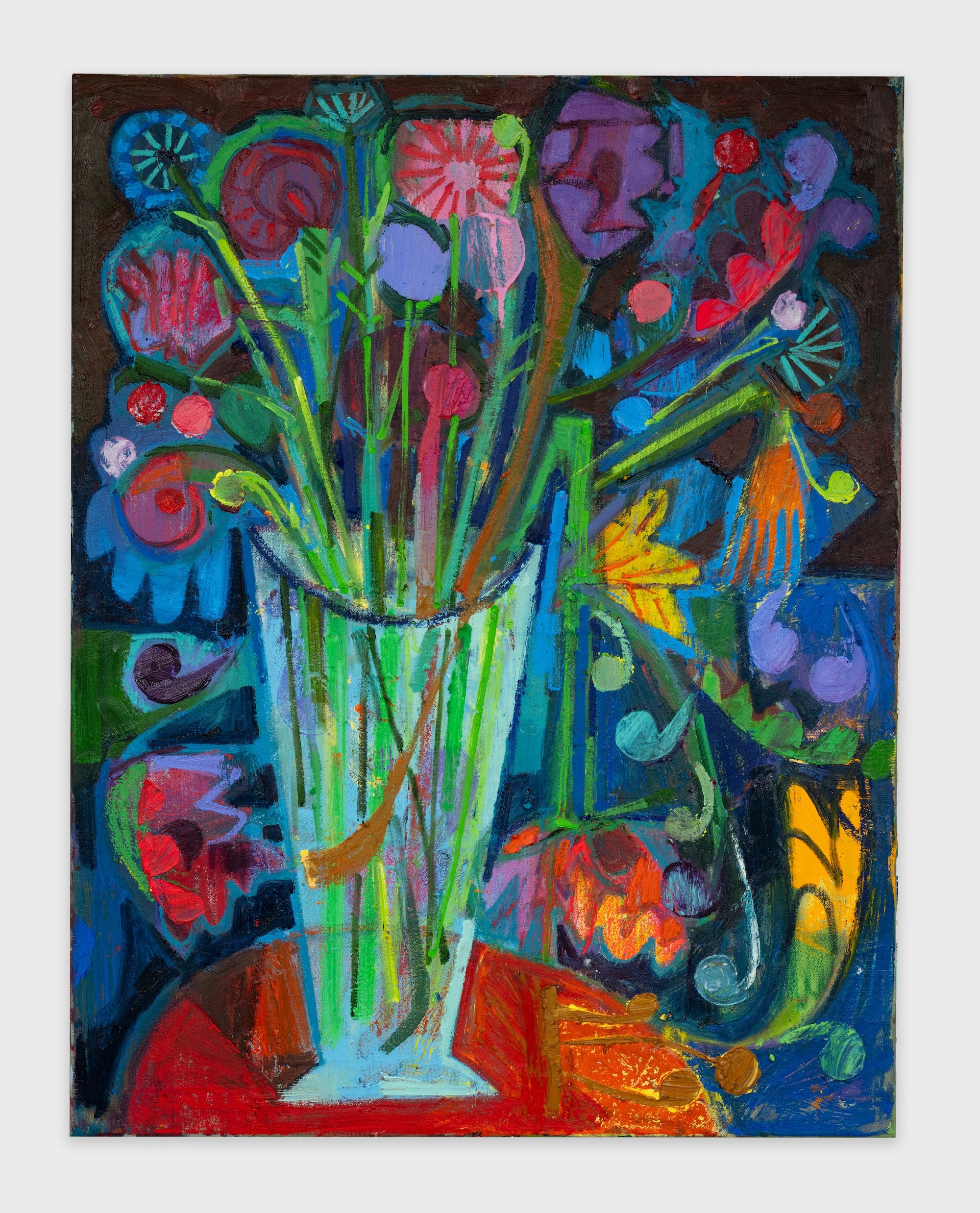
CAE 65’s featured artist is Andrew Salgado, whose piece “Funeral” below drew me to it as I wandered my way around Instagram. I clicked on the artwork before I saw its name. The official writeup for the collection describes it as occupying “a space between celebration and mourning, expression and uncertainty.” Andrew painted it during a tumultuous time; he notes that he kept finding himself “between states of exuberance and almost complete despondency”. Given my current state of mind, and the piece above, it felt fitting to feature it this month. Andrew’s talents are recognized worldwide, and in 2017, he was the youngest artist ever to receive a survey exhibition at The Canadian High Commission in London. He’s also received extensive press both online and in print. Currently, he lives and works between London, England and New Brunswick, Canada. You can also find Andrew on his website and on Instagram.

The most interesting things I read this month
Start here:
Start here for my faves, then fill up your browser tabs with the pieces below.
🧲 Homing Pigeon Navigation Relies on Superparamagnetic Macrophages Under Overcast Conditions. Am I the only one super excited to learn about superparamagnetic macrophages in pigeons? Hopefully not. We’ve known for some time that birds partially rely on magnetoreception to help them orient their place in the sky. But we did not know how pigeons manage to fly long distances and still find their way home. A study published in Science by Lisowski et al. suggests that it isn’t their eyes or brain that make this homing instinct possible, but rather cells in their livers. The cells in question are macrophages, large white blood cells that have the power to devour foreign debris or other cells (Their name translates to ‘big eater’!). In pigeons, these cells accumulate iron, making the cells superparamagnetic — meaning they can respond to magnetic fields the way a compass needle does. They give pigeons an internal compass. The study found that on cloudy days when the pigeons couldn’t see the sun, the birds without magnetic macrophages got lost and could no longer navigate home. What we thought might just be an instinct looks like it has a physical and biological basis. Science
👐 Why Am I Left-Handed? I am a leftie, so this is up my alley. The author of this piece, Natalie Wolchover, is too. It turns out why we’re left-handed remains a surprisingly deep biological mystery because, unlike many traits, it arises from a complex interplay of genetics, embryonic development, brain organization, and chance. It doesn’t come from a single inherited gene. Two left-handed parents only have a left-handed child 25% to 30% of the time. (For what it’s worth, neither of my parents are lefties.) Researchers have identified 40 gene variants that may result in left handedness, but each makes only a tiny contribution to the odds of being left-handed. Many of those genes tie to how the body’s left / right asymmetry is established in early development, and I was surprised to learn that a fetus’s dominant hand is established even before the brain has finished wiring itself to the rest of the body and limbs. Researchers think that hand preference begins via the spinal cord, not the brain. Still, family data (including data on twins) suggests that genetics is just a part of the overall picture. No one has a good answer yet for the rest. Why are only 10% of humans left-handed? Why are humans the only mammal with this kind of preference for right-handedness? Other species have individual foot (or paw!) preferences, but no population-level skew like us. Maybe one day we’ll figure it out! Quanta Magazine
🎨 What Would It Mean to See a New Color? (archive link). Last year, researchers at UC Berkeley used lasers to stimulate a single class of cone cell in five people’s retinas and produced something none of them had ever seen: an impossibly saturated blue-green colour that they named “olo”. It’s a colour that cannot be photographed, printed, or mixed as a pigment because it … well, it doesn’t exist within the range our eyes can register from ordinary light. HOW CONVENIENT. I’m kidding, I’m kidding. In this piece, we get to hear from colour scientists and philosophers on what it actually means to manufacture a new hue rather than discover one, which is all pretty interesting. In addition to describing how vivid olo is, the piece also talks about the social and cultural attachments we have to colour, including a discussion about colourblindness and other physical, neurological or even psychological angles on the topic. As a kid, you think colours just ‘exist’ and there’s no room for new ones, yet here we are inventing them. It’s one thing to learn blue feathers aren’t actually blue, but another to realize that we’re range-limited in other ways. The New Yorker
🤖 A.I. Is Giving Us Answers Right Away. That’s Making Us Dumber. There is much published these days about AI specifically, and tech generally, but this piece hits at a more meta (no pun intended) concern about the ways that technology is changing our ability to function. This short opinion piece is by Dr. Anne-Laure Le Cunff, “a neuroscientist who studies curiosity” (um, hi, please be my friend) who also used to work at Google. It focuses on how AI is interfering with curiosity, not because we don’t want to know things (we do), but because biologically curiosity is predicated on a timing gap between what we want to know and what we find out. Research has found that while we’re waiting for the answer we need, our brain’s reward circuits are activated and new memories can form. These days, the gratification and answers are immediate — which worries Dr. Le Cunff. “If we build a world that delivers only what is asked for,” she writes, “we will lose the capacity to discover what we didn’t know to ask.” The loss of open-ended curiosity won’t lead to a smattering of new lawsuits or regulatory changes, but it may just change how we think. Curiosity puts the entire brain into a mode of heightened receptivity about the question at hand and also everything around it. We’re hampering ourselves by closing that window via technology. New York Times
🐦⬛ Are Crows Really Our Friends? My unscientific answer: obviously, yes. This piece goes into a more scientific examination in its genuinely delightful investigation into whether the crows that many of us try to befriend actually reciprocate the feeling, or if they are instead just training us as a reliable food source. Crows are smart, and can easily see that bringing gifts to humans gets them more food. Some experts think that’s all it is, while others like Thom van Dooren, who wrote “The Wake of Crows”, believe crows relate to people in ways that “meet several conditions for friendship.” We do know that they have long lives, alongside incredible memories and they hold grudges — could they very well be trying to be our friends? We humans love a good story, and it’s far more whimsical to have your own murder of crows to do your bidding than it is just feed the birds. Being from Audubon, the piece includes a sidebar about how to mindfully befriend a crow, for those of you who now want one of this charismatic corvids in your life. Audubon
⚫ The Anti-Slop Music Resistance. Angine de Poitrine, two costumed time-traveling aliens from Saguenay, Quebec, are 333 years old (allegedly) and play microtonal math rock in polka-dots. They went from 50,000 weekly streams to over 10 million in the space of about three months this year, and Luc Rinaldi’s piece on them attempts to share why. At a time when AI can churn out forgettable pop in seconds (like I shared in CAEs past with Spotify’s own AI-slop), audiences are starving for anything unique. In this case, it’s experimental rock centred around complex microtonal compositions, custom double-neck guitars, and quarter-tone frets to create looping, hypnotic, and craaaazypants soundscapes that will (may?) hook you in. Some people think they’re just a schtick, but they’ve been around for many years and built a dedicated fan base long before they donned polka dots. Dave Grohl called their music mind-blowing, and I tend to agree. But I’d add that it’s mind-blowing and deeply, weirdly, beautifully human. Maclean’s
📈 Has America Crossed the Asshole Threshold? Is there actually a tipping point where a society has too many bad apples that it tips into an inability to function? Carlyn Beccia thinks so. Once we hit the ‘asshole threshold’, where enough people believe that kindness and cooperation and honesty are for suckers, the whole system starts to unravel. What could be a simple opinion piece is way more fun; it’s a rigorous historical investigation of the same asshole question. From Hesiod complaining about his brother bribing judges in 700 BCE, through Polybius, Sallust (himself a hypocrite and a crook), Ibn Khaldun, and finally into actual 20th century game theory and a mucho depressing 2024 PLOS ONE paper that measured how many Americans currently endorse political violence (too many). The piece also notes that America clawed itself back from a relatively identical asshole-ish point during the Gilded Age, where it displayed similar warning signs of declining social cohesion and a distorted wealth curve that we have now. Changes did not happen through any one person, but through ordinary people creating collective institutions like unions and mutual aid societies, and through journalists, reformers, and activists who made corruption less rewarding. “Every era’s turnaround began the same way,” Beccia writes. “Some unmeasurable number of people, each acting alone, declined to sell — and then made the single most subversive move available to a member of a collapsing civilization.” Let’s hope we can find one another and make decency viable again. The Grim Historian
🧠 The Terrorist in the Brain. Several diseases fall under the dementia umbrella: Alzheimer’s, frontotemporal dementia, Lewy body dementia, and more — with some overlapping symptoms but also very different pathophysiologies among them. It’s not one disease, nor even a cause; it’s a description of a problem, a general term that sometimes leads to inaccurate detective work for the underlying condition and most definitely inaccurate reporting in the media. Dr. William Meller’s writing uses Robin Williams and Bruce Willis and their diseases to talk about how even excellent doctors may be misled: Williams was diagnosed with Parkinson’s but he was actually dying of Lewy body dementia, confirmed only via autopsy as one of the most severe cases the examiner had ever seen. His widow later wrote a paper calling Lewy body dementia “the terrorist inside my husband’s brain”, which feels apt given how it lurks and confuses. Seeing family members succumb to this “unseen dark” leaves me helpless when medicine has no solutions. Dementia of all kinds doesn’t discriminate in whom it fells. The article also addresses some of the issues in treating Alzheimer’s, such as retracted research, a massive supplement industry that knows “fear is a superb business model. It also gives advice about prevention as we age. Skeptic
👣 PTSD Therapy Walks Patients Through Past Trauma. Confronting images of traumatic memories while walking on a treadmill shows remarkable promise of recovery, per a new paper from the University of Alberta. Their researchers have published new peer-reviewed evidence for 3MDR (Multi-modal Motion-assisted Memory Desensitization and Reconsolidation), a therapy that has patients guided by a therapist in real time while walking on a treadmill toward a screen that shows them images and music tied to their own trauma. The modality began with veterans and first responders, and has since expanded. Researchers described improvements over a matter of weeks that talk therapy alone might take years to produce, and those improvements lasted for at least a year post-treatment. Like the research about playing Tetris and trauma, or the repetitive eye movement (or tapping) that accompanies EMDR, this hopefully brings some support to people who need it most. I do tapping with EMDR because moving my eyes back and forth with a spinal CSF leak is painful, and the repetitive movements take sufficient concentration that I don’t sink too deep into the activation of my memories. Here, the physical act of walking ‘toward’ the trauma may play a role; either way, 3MDR seems to change how the memory gets processed. You can also read the open access paper. University of Alberta Folio
😞 Not Just a Headache. I don’t think I need to explain to any of you why this one is included! Amy Hassanein, who I’ve had the pleasure of meeting virtually as a patient, writes poignantly about spinal CSF leak. She previously knew of the condition as ‘a headache’ since that is how the symptoms are most described, but in reality the condition is so much more. She shares what the ‘much more’ is for her: feeling like you’re on a rocking boat when you’re upright, the unpredictability of symptoms and loss of trust in your own body, the constant uptime calculus, and many other aspects of leaking that long-term CAE readers know by now. It “can feel like being pulled deep inside your own body, wrapped inside incessant head and sensory pain, while the world around you blurs into something you need to escape,” she writes. Consumed by pain, it’s difficult to participate in the world around you, even in small slivers. A Different Bloom
😁 This 22-year-old engineer 3D prints dentures to give low-income Americans their smiles back. Connor Gibson had no background in dentistry or in 3D printing when he started volunteering with Remote Area Medical (RAM), a nonprofit that runs free mobile dental clinics across the USA. He did, however, notice that the traditional process to make dentures for a patient took a long time, often close to 3 months. This meant that for patients who were so rural they couldn’t make it back to a clinic, it could take up to a year to get their much-needed dentures. So he taught himself as much as he could about both fields and built the USA’s first mobile denture lab that RAM could use as they traversed the country. With two 3D printers “humming 24/7 until all patients are outfitted”, this summer he set a record of 35 dentures printed in one weekend. Instead of months, dentures are ready within minutes. Close to 27% of Americans have no dental insurance, and Medicare does not cover dentures, so his 3D printed lab integrated into RAM is making a difference every day. CNN
🥵 More Fucked Today than Yesterday. Yeah, this piece isn’t uplifting like the last one. Climate scientist Eliot Jacobson does exactly what the title promises: a blunt recital of how many consecutive days the planet’s oceans have spent breaking daily heat records (55, at the point he wrote this) and how far outside historical norms we now sit (3.8 standard deviations, for the stats-minded). There’s no silver lining here, but there doesn’t appear to be one for the planet either — though you wouldn’t know it from much of the social discourse these days. Climate Casino
♀️ Listening to Cassandra: Misogyny, Classical and Modern. “Sometimes it feels that there is nowhere I can turn without running into violence against women,” Rebecca Solnit writes in her opener to this piece. The news is full of such violence, yet it is nothing new. Solnit looks back at the silencing and subjugation of women over time. There’s a connection between ignoring women’s voices and the violence that follows such dismissal, and the world has long been willing to attack women, physically and reputationally. In the modern era, technology makes that even easier, with online vitriol and death threats alongside practices of sexual assault. In CEGEP, I took a course called “Wicked Women in Literature” about women protagonists who ran the show. This piece is the opposite, with Telemachus silencing Penelope, Cassandra’s rape in the aftermath of the Trojan War, and other examples of how classical literature normalized rape, sexual slavery, and the exclusion of women from public speech. We see that today, too, in the outrage about Emily Wilson daring to translate Homer from a female perspective. Contemporary misogyny connects to thousands of years of ancient misogyny, and silencing women allows it to fester. Having a voice means having the social right to define yourself, to set boundaries, to give or withhold consent, to be believed — something women are rarely allowed to do without consequence. Meditations in an Emergency
🔴 Margaret Atwood on How She Came to Write The Handmaid’s Tale. Related: this is an older piece from 2018, featuring Margaret Atwood’s own account of writing Handmaid’s Tale in 1984 while she was living in West Berlin. The title of the book was initially “Offred”, and it only became The Handmaid’s Tale when she was close to 150 pages into writing. I’m sharing this here because it came up in a group chat where we discussed the series and its prescience. Atwood says, here and elsewhere, that she built the plot from the horrors of humanity that existed already. “I did not wish to be accused of dark, twisted inventions, or of misrepresenting the human potential for deplorable behaviour,” she notes. We have plenty of that in our archives, and all of the terror she puts to paper existed within them already. Atwood is clear, too, that while Handmaid’s Tale has been called a “feminist dystopia”, the term is “not strictly accurate.” Gilead is instead “the usual kind of dictatorship” shaped like a pyramid, with powerful people of both sexes at the apex. This book was required reading in high school for me, and Atwood is a literary treasure. I’m always keen on learning what goes on behind the book, and thought you might be too. Literary Hub
🎵 Vinyl in the Veins. An excerpt from Kyle Devine’s new book Recomposed, on the uncomfortable consequences of vinyl records now surging in sales: every record is made of petroleum products. I had no idea! Devine covers a Hollywood conference panel discussing sustainable vinyl made from recovered ocean plastics and soy-based ink, as well as a smaller green pressing plant near Vancouver, where the punk musician owner hand-drills paper labels out of unsold records so that they can be reground into new ones. Recycling the world’s records can’t keep up with the market’s voraciousness for them, and it’s therefore only a partial fix to re-use them at all. “If ever there was a good time to make records out of something other than polyvinyl chloride,” Devine notes, “that time is now.” Longreads
♥️ A Love Story: Tracking Thousands of Couples During the Pandemic. In this creative, interactive piece, Alvin Chang takes a Stanford dataset that followed the same couples through 2017, 2020, and 2022 to visualize what happened to those relationships during the early days of the Covid pandemic. Overall, existing relationship quality was amplified; strong relationships became stronger, and couples who rated their relationships as weaker deteriorated further leading to breakups and conflict. Stanford researchers found that “mutual meaning making” was found in relationship successes: the couples whose perspectives were aligned about how seriously to take the risk of Covid were more resilient. The piece extrapolates on this finding to look at marriage and relationships in a social/historic context. Marriage has evolved over time, and while modern love provides more freedom and fulfillment it also places extraordinary pressure on couples to be all of the things that a village once did. The Pudding
The rest of the most interesting things I read this month:
📸 A few photography award roundups to make you smile and think this month:
iPhone Photography Awards (IPPAWARDS), with its 19th annual winners
Berlin Photo Awards, with its 2026 winners announced
and from February, the Close Up Photography of the Year winners for 2026.
🏈 Study Finds NFL Players Four Times More Likely to Die Due to Neurodegenerative Disease. Not unrelated to the piece above about how dementia is ‘unseen dark’: the largest retrospective study of its kind on neurodegeneration and American football looks at nearly 20,000 former NFL players going all the way back to the 1960s and finds that they have significantly lower all-cause mortality than the general population (fewer deaths from cancer, cardiovascular disease, and suicide) but nearly four-times higher neurodegenerative mortality, including all-cause dementia (3.8-times higher) and Parkinson’s (3.88-times higher). Those who died before age 60 had more than 12-fold increased rates of neurodegenerative death compared to the general population. In addition, players with longer careers (5+ seasons) had nearly double the risk of neurodegenerative death compared to those with shorter careers (1–4 seasons), so there is a “dose-response” relationship involved that we’ve previously seen in studies I shared about chronic traumatic encephalopathy (CTE). Mass General Brigham
👥 North Americans Have Depressing Relationships. I am not Romanian like the author, so I can’t speak to the differences between Romanian culture and ours, but it is an interesting read about the culture shock of encountering North American relationship norms after growing up elsewhere. The author argues that North American relationships are fairly individualistic, heavily-boundaried, and independent — and therefore emotionally isolating. We “agree to disagree” and avoid over-inconveniencing each other. Romanian relationships, in contrast, are a lesson in interdependence, an unspoken agreement to be changed by another. You argue through disagreements until you reach a shared understanding; you show up for each other in person and generally. The author believes North American culture’s emphasis on autonomy and emotional self-sufficiency leads to a loneliness that persists even if one has many friends. Will they actually come when you need help? The author gives examples where people refuse to be inconvenienced by their friends, but as someone living a fairly inconvenient life, people have shown up in droves. Instead of actual closeness, the author asserts that trauma dumping has become the only socially-sanctioned way to ask for unconditional care that ought to be assumed. The piece is polarizing (a lot of the comments push back), and an interesting read from outside the fishbowl for those of us in North America. The Sixth Spence
🍖 Ketogenic Diet Shows Opposite Effects on Cancer Risk in Mouse Small Intestine and Colon. A new study out of MIT found that mice on a ketogenic diet had increased small-intestinal tumours, and suppressed colon tumours. Interestingly, the increase is not fuelled by ketones but rather by how intestinal cells process the large amount of dietary fat in many ketogenic diets. The same diet also reduced colon tumours, but researchers have not yet figured out exactly why that is in contrast to the increased small-intestinal tumours. These are mice genetically predisposed to intestinal cancer, so we shouldn’t be running with the conclusion. I’m sharing it because there is a lot of discourse around gut health these days, and ‘the gut’ isn’t one thing — it’s many different parts. As this study shows, we shouldn’t assume that something has benefits for it all just because one area shows a benefit. Sometimes the body reacts well in one area but poorly in another. Genetic Engineering and Biotechnology News
🇨🇦 Canada Is Primed to Burn. Why Aren’t We Ready? Canada is the only G7 country without a national wildfire agency. Instead, provinces fund and staff their firefighting independently, and the country has now spent more days at its highest national preparedness level in the last three years than in the entire preceding decade combined. Canada’s forests were once reliable carbon sponges, and now are net emitters. The country is increasingly vulnerable to catastrophic wildfires, but our approach to them is mostly reactive and not preventative despite the fact that climate change is creating hotter, drier conditions making more fires more likely to burn uncontrollably. This article argues that we need to focus not only on firefighting but also on forest management, prescribed burning, community preparedness, and building homes/infrastructure that can withstand fires better. We didn’t have a burning season when I grew up in this area, but it’s common now each summer. Sobering read. The Walrus
🦭 The rare seal hideaway on Greece’s abandoned prison island. Gyaros held political prisoners from Roman times through Greece’s 20th-century military dictatorship and was known as the “Island of Silence” as a result. For years, it sat abandoned and off-limits and now (accidentally) became one of the most important sanctuaries in the world for the Mediterranean monk seal, one of the rarest marine mammals on Earth. There are only around 600 of these cuties left in the wild. This piece is short, but as I didn’t know about these animals I thought you might want to learn too. Greece just gave the surrounding waters stronger legal protection to help keep the seals safe. BBC Future
🏋 The Work of Reading About Muscle. This is a footnoted personal reading list that Oliver Bateman built to understand physical culture and bodybuilding, taken from decades of learning. It begins with practical training books that shaped his own lifting, then moves into books that examine the psychology of bodybuilding and how insecurity, loneliness and body-image problems can drive people toward extreme physical transformation. There’s a history of bodybuilding section in here too, which addresses how gyms and bodybuilding have changed over time. It’s an unusual take on fitness, and though I can’t lift any weights any longer I loved doing so when I could. I never thought of it as more than a general health practice when I did, and could have benefitted from understanding lifting as more than just a physical habit. Oliver Bateman Does the Work
🌭 America’s Greatest Hot Dog. An entertaining love letter about why the Costco hot-dog-and-drink combo has become a beloved cultural institution. It hasn’t moved in price since its inception in the 1980s, despite inflation. Costco treats it like a member perk not a product, and during their 2025 fiscal year, they sold 245 million of those combos. Costco’s customer-friendly philosophy is reflected in the choice, and the article shares that when someone once tried to raise the price cofounder Jim Sinegal said, “If you raise the effing hot dog, I will kill you. Figure it out.” Costco makes its own hot dog and uses freshly steamed buns, and the snack has been fairly consistent over time, unlike many other long-term consumables that are either expensive or enshittified. The Ringer
🦠 COVID-19 Can Wake Dormant Viruses in the Body, Large Study Confirms. I’ve been saying this in CAE for years, and here we are again: another large study, this one following more than 1,000 hospitalized patients and published in Nature, confirms that a SARS-CoV-2 infection can reactivate other viruses already lying dormant in your body. Nearly half of patients had at least one virus ‘wake up’, most commonly herpes simplex virus 1 and other viruses like EBV and CMV. Reactivation tracked with how sick people got, and with the lingering fatigue and brain fog that often are attributed to Long Covid. What I appreciate about this paper is that it looks at why patients are experiencing longer-term symptoms, and not blaming them on the patient themselves. As I keep saying, it’s the virus that is doing something to the body, something measurable. We’ve known this for years, and there’s a second review paper about shingles specifically and how Covid can reactivate varicella-zoster virus, too. It’s good to see this research, though sad overall given how many are suffering. Science
🥄 Shut Up About Spoons If You Have So Many. Speaking of suffering: this is a rebuke of how “spoon theory” has moved into the mainstream, and the author believes this dilutes its application for those who actually live it day in and day out. I hadn’t thought about his point prior to reading, though it is certainly true that ‘having enough spoons’ has moved into common lexicon for when people are tired — regardless of whether they’re able-bodied and healthy. Do we have the right to police the way people use words? This is an argument as old as time, but in this case and as someone also very unwell, I understand the frustration in losing a means of bridging the communication gap because words have lost the weight of their initial meaning. Malaisey Days
📱 The Shape of Apps. You all know I love a niche piece, and this one takes us down the rabbit hole of design specific to app icons. Why, pray tell, does every app icon on iPhones (or Mac computers) look like a rounded square? I did not wonder this before, but this is why the internet is marvellous. Apparently, this shape is called a “squircle”, at least per Apple’s powers that be. Take an illustrated trip from the initial Mac OS X–era icons, that brief window under Mac OS Big Sur where designers could be a little more fun, and now… “squircle Jail,” where anything that doesn’t conform gets shrunk down and boxed in. Why did Apple do it? Not necessarily for aesthetics, but because developers weren’t going to design well without a less stringent system. Might as well smush everything into a squircle, I guess. Parakeet
🥶 How Kalshi Infects the News. A joint investigation from Aaron Rupar and Judd Legum looks at how thoroughly CNN and CNBC have integrated the prediction market Kalshi into their actual news coverage since they papered a deal with the company in December 2025. There are dozens of CNBC articles that are basically Kalshi advertorial. There’s also a recurring CNN segment called “The Odds” where the chief data analyst treats Kalshi odds as more reliable than polling, which is particularly misleading because Kalshi’s political markets haven’t been that accurate and a recent study found that they distort odds to make unlikely events look too likely and likely events look less certain. Cool, cool. No conflict here! Oh, wait. They aren’t disclosing their commercial relationship with Kalshi when they talk about them? Yikes. Sure, prediction markets can be a useful data point, but as prior CAE pieces have said, and this article reiterates: news organizations should not present gambling market odds as objective forecasts, especially if they have a financial incentive to promote the market. Double especially if they forget to tell us viewers about the conflict of interest. Public Notice
🔗 Quick links
A device that revives eyeballs from dead donors could make eye transplants possible.
Researchers find women with Long Covid report more neurological symptoms, greater quality of life impacts and worse cognitive performance than men.
Build a 3D model of Jimothy running.
A great crash course in learning how to cook.
Marmots star in OnlyFans account as researchers desperately look for ways to raise funds amid US budget cuts. OnlyMarms?
New magic mushroom makes people see tiny gnomes, and scientists have no idea why.
Hope you enjoyed these links! See you next month,
-Jodi
A joy as always. And I like that (I think) you have more of a tendency to editorialise around each link than you used to? Bring it on - I want all this stuff filtered through your immense, hyper-connecty brain.
I missed the Anne-Laure piece! Thanks for that. She's concluding what I've been pondering as well - the value of sitting with questions, and the way an unresolved answer is such a powerful creative engine (and also a creator of alternative explanations, which is part of it too). It's like we're being taught to equate information gaps with a kind of discomfort we need to kill as quickly as possible, like the way we've become so uncomfortable with introspection that we will literally electrocute ourselves to avoid it, as that now-famous study demonstrated: https://www.science.org/content/article/people-would-rather-be-electrically-shocked-left-alone-their-thoughts
😮 this one is a home run. I really don't know if it is 'serendipity' because it just about covered all bases. Good one J❣️🤙