

The Curious About Everything Newsletter #59
The many interesting things I read in January 2026
Welcome back to the Curious About Everything Newsletter! CAE 58 is here, if you missed it. The most popular link from last month was Tom Whitwell’s compendium of the facts he learned during 2025.
My updates
In November, I was asked to speak alongside an expert in the field of spinal CSF leak in an honest conversation about barriers to accessing care. Patients are misdiagnosed, they’re not believed, and with an invisible illness, care is often significantly delayed. I shared the patient experience as best I could, talking about how so many patients are stuck in limbo, and in bed. For those interested, you can listen to the conversation, or read the transcript.
I published my celiac’s guide to Turkey, a tough country to travel in when gluten free because it has a lot of hidden wheat. Wheat is thought to have been first domesticated in Southwest Turkey 10,000 years ago, so I suppose I shouldn’t be surprised! My guide has both a list of safe/unsafe foods for celiacs, as well as a Turkish translation card to use in restaurants or stalls.
CAE 58 overflow links, a crash course in ‘exploding trees’ during cold weather, and other updates are here.
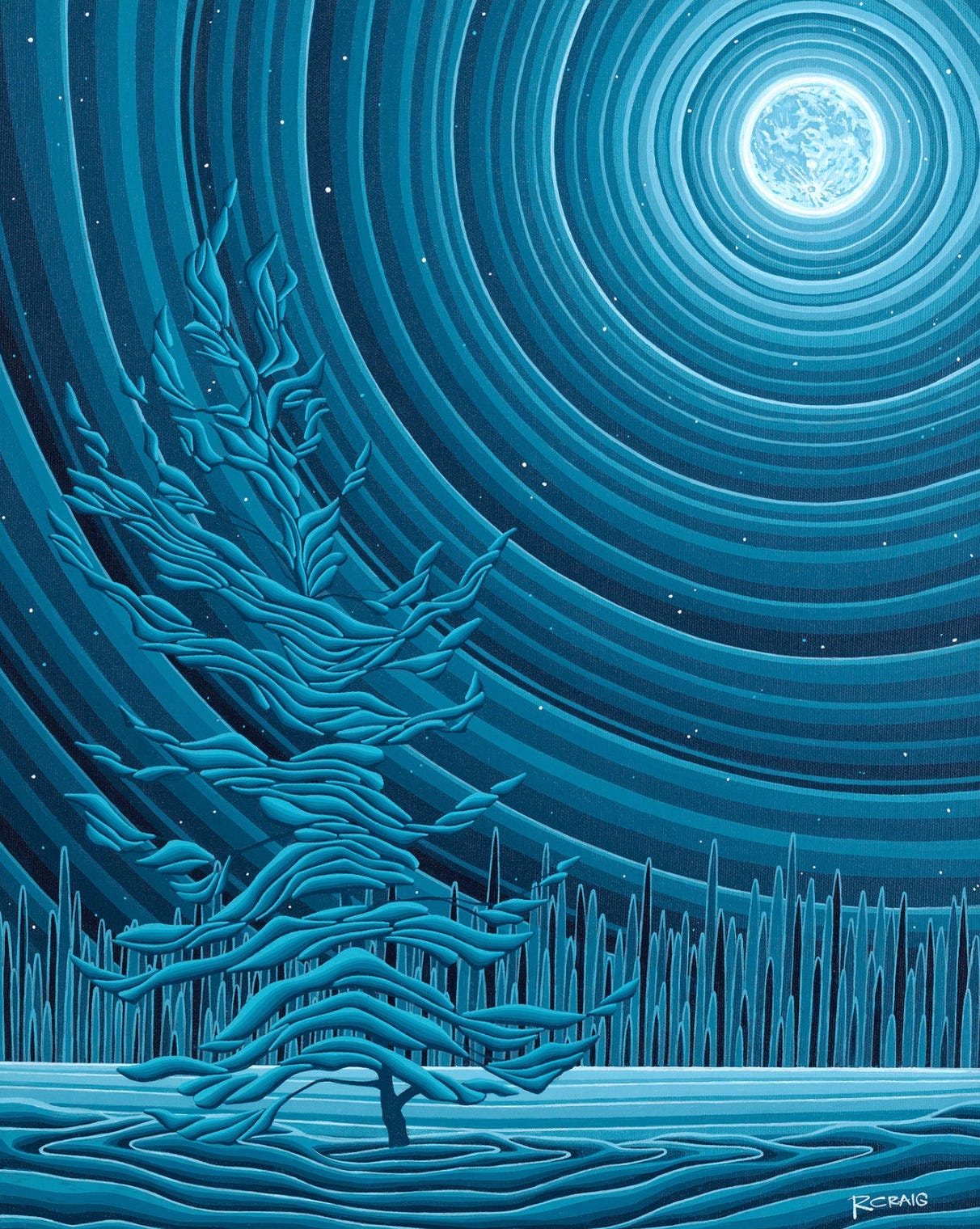
Featured art for CAE 59
CAE 58’s featured artist is Robbie Craig, who I was first introduced to by a friend living in Canada’s Northwest Territories. Robbie grew up in Barrie, Ontario, and attended teacher’s college while painting on the side. After obtaining a job in Canada’s Northwest Territories, he says he was drawn to the rugged landscape, tundra, and crooked “Seuss-like” trees”, and knew he’d found his home. The beauty of the North inspired his paintings, too, and I find his landscapes beautiful and peaceful. The thumbnail image for CAE 59, is from his piece entitled “Night of the Jack Pines, and the image below is entitled “Beneath the Moon Glow”. I love his work, and if you do too you can find him on Instagram and on his website.

The most interesting things I read this month
Start here:
Start here for my faves, then fill up your browser tabs with the pieces below.
🇨🇳 2025 Letter. I’ve shared Dan Wang’s annual, reflective post in CAEs past, and as with earlier editions his 2025 letter is thoughtful and thought-provoking, about China, geopolitics, and much more. In discussing AI, he does so via a different lens to what we’re used to, specifically how the West’s deployment of AI differs from China’s approach. “Silicon Valley has done a marvelous job in building data centers,” he writes, “but tech titans don’t look ready to plan for later steps in leading the whole-of-society effort into deploying AI everywhere.” In contrast, the Communist Party “lives for whole-of-society efforts” and China has set targets for AI across society — something the West often ignores. The result is that the West’s use of AI is very present-driven (presentations, written work, building current things) or theoretical (discussion of superintelligence or winning a race) whereas in China, the aim is on scaling via existing manufacturing and braiding AI into processes to make them even more productive. Wang isn’t an AI sceptic, but thinks we ought to be talking about “winning the AI future” as a wholesale approach across society, instead of the specific pockets of focus we seem to be obsessed with here. He goes into much more detail than my brief summary can hold, and it’s worth your full attention as it is every year. In his astute analysis is, as always, personal anecdotes and reflections. Dan Wang
🪹 Got Beef With Cowbirds? This Researcher Wants to Change Your Mind. Have you heard of a cowbird? The brown-headed cowbird (to be precise) is a fascinating species known for its “brood parasitism”, meaning that it lays its eggs in the nests of other birds to be raised by unsuspecting foster parents. While cowbirds are often dismissed by birders as villains or “lazy” parents, I learned so much in this piece that surprised me. For one, scientists now think the cowbird has complex cognitive maps in its bird-brain to keep track of dozens of nests simultaneously. Plus, how do the younger cowbirds recognize their bio-parents? (A “password” of chatter, apparently!). The researchers interviewed for the piece talk about other findings that challenge the common perception of cowbirds, including more about how the young cowbirds transition from host nests to independence. I confess I previously fell into cowbird tropes, so I’m glad to be corrected. Audobon
🚰 Thirteen Waters: Tasting Notes from a Sommelier. In last month’s CAE, we learned about the The Berkeley Springs International Water Tasting competition, a gathering place for the world’s most passionate drinking water enthusiasts. So this piece by a water sommelier (yes, an actual thing — TIL, again) caught my eye. It shares delightfully curated tasting notes for thirteen different waters, ranging from still and mineral to sparkling. Following a similar writing style to what we’d see in wine tasting notes (“a pleasant and harmonious water, also of decent mineral composition”), each water here also includes contextual references and musings that make this piece a fun addendum to the Walrus article I shared in CAE 58. The Paris Review
⏰️ Who Sets the Doomsday Clock? You may have seen that the Doomsday Clock ticked closer to midnight this week. In this timely piece, I got to learn more about where it came from. Humans have been “telling stories about the apocalypse for thousands of years,” but the nuclear age marked a new reality “that our end could be self-inflicted,” Emily Strasser writes. The Doomsday Clock was an early symbol of that awareness, beginning as a sketch to convey the “panicky time” of the post-WWII era in 1947, with the then-constructed clock’s arms moving as history marched on. The clock began under the spectre of nuclear war, but now factors in climate change, disruptive technologies, geopolitics, and biological threats. It’s meant “to be a warning and a call to action, not a prediction”, and yet it seems to be mostly falling on deaf ears as high level existential threats persist. A few days after publication, the clock’s arms were moved even closer to doomsday, the closest that they’ve ever been. Popular Mechanics
🐧 Rockhopper Penguins’ Athleticism Makes Them the Daredevils of the Animal World. Will a Warming Climate Slow Them Down? I’m no penguin connoisseur, so this was a fascinating look at one of nature’s most spirited waddlers: the rockhopper penguin. Clambering up and down the cliffs of the Falkland Islands (Islas Malvinas to those in Argentina, as I was reminded often when I visited), these “little balls of muscle with outsize personalities” survive by sheer grit. They are the smallest penguins to rush around in the cold, rough waters north of Antarctica, but how much longer can they withstand a rapidly warming ocean? As rising temperatures shift the location of their prey, Rockhopper penguins are being forced to swim further and dive deeper, burning precious calories they can’t afford to lose. I loved the affection with which researchers describe these birds, but the sobering reality remains that our world is changing. And yes, there are plenty of bonus cuddly penguin pictures inside. Smithsonian Magazine
🧮 Why can’t I just meet you for dinner? Extremely relatable piece about the calculus required to manage ME/CFS in an able-bodied world. I write about the “abacus” of sliding beads around all day, to figure out what I can and cannot do with an active spinal CSF leak. Fred Rossi talks of the accounting in his head that he has to do when someone asks to make plans with him, and explains that his fears are not about “feeling tired”— or even mere exhaustion. Rather, it’s PEM, post-exertional malaise, a “systemic crash that occurs after physical, cognitive, or emotional exertion that exceeds your body’s brutally reduced energy envelope.” I’ve talked about limited bandwidth but that, too, feels insufficient to describe the crash that follows exceeding it, not to mention how long it takes to return to a normal baseline. The math has to factor in not just a “flare”, but also the decline that often follows. It’s a thoughtful piece that peels the layers away for people without chronic conditions like ours, and I appreciate him writing it. Center Left
⌛ Effort Without Improvement. Similarly, this shorter read hits home. “It’s still hard to accept that I have to make as much effort as I do to never get better. And despite understanding, intellectually, that I am chronically ill, my brain continues to search for the magic pill.” I’ve written that I have hope that medicine may evolve to seal me one day, but that day is not here, and I do not know if it will ever be here. Society struggles to process those of us left in interstitial ‘waiting’ spaces, and sometimes I forget that I shouldn’t compare my current body to my pre-leak body, that I shouldn’t be so hard on myself for needing so much rest. Kristie De Garis
🧅 I sell onions on the internet. From 2019, this post was resurfaced by The Browser and shares a man “addicted to domain names” who randomly bought an onion-related domain for $2,200, and then built a very successful farm-to-fridge business that delivers Vidalia onions. I’m biased, I should admit; they are my favourite onion. I really enjoyed this short read of someone with no onion expertise who unexpectedly found a gap in a marketplace, and then filled it. Deep South Adventures
🫀 Light Exposure at Night and Cardiovascular Disease Incidence. A very interesting study: researchers found that people exposed to brighter light at night faced higher risks of heart disease, while daytime light may protect the heart by reinforcing healthy circadian rhythms. I’ve written about chronobiology for years now in my post about jet lag, and I think this growing field will be very important to how we manage interventions in the future. In this study from October, resurfaced for me by Ryan McCormick, M.D. (thanks Ryan!) researchers tracked around 90,000 people for almost 8 years, which yielded a staggering 13 million hours of light exposure data. The study found that people with the brighter light exposure during sleep had a 56% higher risk of developing heart failure over those sleeping in darkness, as well as a 47% increased risk of heart attack, 32% higher risk of both coronary artery disease and atrial fibrillation, and 28% elevated stroke risk, though causality cannot be inferred. Over on Patreon, I covered a study addressing whether inflammation can cause depression in people with insomnia (the answer is yes), and my writeup included advice on how to sleep better (as a prior insomniac!). For those who don’t want to click over: advice included blackout blinds, using dim, non-overhead light after sundown, keeping “Night Shift” on your devices as soon as the sun sets, using a SAD lamp in AM, and more. JAMA
⚓️ New Arteries, New Power. (Archive link) Different kind of arteries for this one! You’ve likely seen news reports about undersea cables that supply the internet to a variety of countries, and how cutting them significantly disrupts function in those countries. This article is a deep dive into those subsea fibre optic cables that carry nearly all of global digital traffic. The cables have become a critical but increasingly friction-filled area of geopolitical maneuvering, and their vulnerabilities are especially pronounced in Europe. Increased vessel and submarine activity along Atlantic and Baltic routes have also “heightened concerns about undersea surveillance, as adversaries map and monitor critical cable routes”, Lynn Kuok writes. The laws are outdated — the UN Convention on the Law of the Sea (UNCLOS) was from 1982. We desperately need a “a comprehensive global architecture that links national and regional efforts with international ones and modernizes the legal and institutional regime”, and while the US was well-positioned to lead this effort …. lololol now, right? Good luck with that. Maritime Law was one of the most interesting classes I’ve ever taken during my legal studies; it’s hard to believe UNCLOS has not been modified since. We really need new rules for the deep. Foreign Affairs (And: related bonus, maps of the sprawling networks of undersea cables from over time, via Kottke.org)
✨ How Will the Miracle Happen Today? A beautiful read by Kevin Kelly about accepting kindness from strangers as a spiritual practice unto itself, one developed during his lifetime. “Kindness is like a breath,” he writes. “It can be squeezed out, or drawn in. You can wait for it, or you can summon it. To solicit a gift from a stranger takes a certain state of openness.” Accepting the kindness of strangers was a primary step in almost every transcendental experience I’ve had while traveling, and I did often worry about the burden of my presence in their lives. Kelly writes of staying in strangers’ yards while cycling cross-country, never once being turned away and often being invited inside for dessert and conversation where his role was to “help them enjoy a thrill they secretly desired” by recounting his adventure. He argues that being “kinded” is an unpracticed virtue requiring surrender, a deliberate willingness to be helped that transforms the question from “will I be helped?” to “how will the miracle happen today?” Drawing on his experience, he suggests true spiritual faith rests not on hope but on gratitude, something I agree with. The state of being alive is itself an unearned gift, brimming with ‘what ifs’ — even when life goes pear-shaped, as mine has. A big part of how I’ve mentally survived has been to live in a place of possibilities. Not as a state of disassociation or delusion, but to opt to sit in the gratitude of still being here, no matter how small of a sliver I have to do so, and no matter how bad things get. Kevin Kelly
The rest of the most interesting things I read this month:
🇧🇷 Under the Cowboy Hat. Interesting read about a new sub-genre of music in Brazil, called “agronejo. Originating as an offshoot of sertanejo, Brazilian country music, agronejo lyrics celebrate cattle ranching, soy farming, trucks, rodeos and modern farm technology in songs that have gone viral online. Also, um, pesticides: singers Adson & Alana sing in a song outro, spray that poison from the plane!. Critics highlighted in the piece argue that agronejo’s upbeat portrayal of the agricultural industry dovetails with the political and economic power of agribusiness in Brazil, where a large share of their government is aligned with farming interests, and environmental and land-rights issues are contentious. Plus, pesticide contamination incidents have risen sharply. Like, really, really sharply: an 858% (!) increase in 2024. The genre’s success, including stars like Ana Castela, reshape agribusiness’s image in a way that appeals to younger audiences, but it does it while normalizing an industry that profits at the expense of Indigenous rights and Brazil’s working poor. The Dial
🔎 A century in the Siberian wilderness: the Old Believers who time forgot. In this engaging piece by Sophie Pinkham, we are transported to the depths of the Siberian taiga to revisit the story of the Lykov family, “Old Believers” (a traditionalist branch of Russian Orthodoxy that rejected 17th-century liturgical reforms) who fled religious persecution in Russia in 1936, and lived in near-total isolation for over forty years. By the time a group of geologists stumbled upon them in the Sayan mountains in 1978, the family had no idea that World War II had occurred, or that humans had landed on the moon. The children had never seen bread, and when offered some they declined saying they weren’t allowed. Their vocabulary was archaic, but their speech had also shifted during their isolation. All told, they spent decades in a near-constant battle with the elements, with some family members succumbing to famine. After their discovery, as is often the case, others passed from illnesses introduced through contact with the geologists. Only one person, a woman named Agafia Lykova, survived into the 21st century. She continues to live largely self-sufficiently in the taiga while intermittently accepting limited assistance and supplies from visitors and researchers. The Guardian
🎰 America Goes for Broke. Early on in my law career, I was tasked with compiling state legislation about sports betting and internet gambling. Like any project that takes a lot of your time, articles on the topic now catch my eye. In this very personal report, Jasper Craven explores the explosive rise of sports betting in America, a shift he describes as a burgeoning “epidemic” that has transformed from a niche vice into a multi-billion dollar cultural mainstay. I say ‘very personal’ because he writes that he has himself wagered over $18,000 online. Drawing a parallel between the current gambling boom and the early days of the opioid crisis, he notes that both are fuelled by ease of access and a multibillion-dollar advertising blitz that preys on those genetically or socially primed for addiction. The piece discusses the “shoddy patchwork” of state regulations and a startling lack of Federal oversight. Sports betting is ubiquitous, especially for men — nearly half of men 18-49 have online betting accounts — and the algorithms push “chasing losses” further. Reporting from Las Vegas, Craven also profiles industry workers, casual and habitual bettors, and recovering gamblers, to share their documented harms. These include not only financial loss, but also alcohol disorders, domestic violence, and more. Harpers
💉 Life on Peptides Feels Amazing. (Archive link) Peptides are building blocks of proteins, comprising amino acids (from 2 to 100, linked together). As this article notes, they are the body’s messengers; “they can tell skin cells to make more collagen, spur muscle growth after exercise, or affect immune activity.” I’ve been interested in them since 2019, when I started writing to researchers about different peptides in reference to my chronic spinal CSF leak, curious as I was for ways to claw back some quality of life as I waited for medicine to evolve. At the time, peptides were primarily used for bodybuilding and for chronic illness, with compounds like BPC-157, KPV, GHK-CU, and MOTS-C featuring heavily. Since, the global peptide-therapeutics market does close to $50 billion in annual sales, with the recent boom mostly caused by the GLP-1R medications like Zepbound and Ozempic. It’s a very caveat emptor situation: many people are not only buying from the “grey market” (mostly labs from China), but testing these compounds doesn’t always yield results that reflect what you thought you bought. Moreover, there is little research on long-term side effects or consequences of some of the peptides, with concerns about cancer risks for several of them. I do wish the article went more into that aspect of the compounds. New York
🧬 The real da Vinci code. Scientists involved in the decade-long Leonardo da Vinci DNA Project now report that they have extracted genetic material from drawings and letters that may be associated with the da Vinci. Samples swabbed from these artifacts yielded human DNA sequences that appear to belong to the same genetic lineage linked to Tuscany, the region where da Vinci was born. The researchers note there is no conclusive proof the material comes from Leonardo himself given the possibility of contamination over centuries from people who handled the items. While researchers have found bones from a family vault (Leonardo’s grandfather’s petrous temporal bone), they haven’t confirmed the Leonardo connection yet as they are still trying to get access to the Amboise tomb where Leonardo himself was buried, or confirm DNA from the mysterious hair lock. The study, published as a pre-print, is part of a larger project that has already reconstructed a multi-generational family tree of da Vinci’s descendants. Whether they will eventually find and authenticate physical remains to confirm a match is up in the air, but this is the closest we’ve gotten. Science.org
😬 How to be less awkward. In his delightful writing style, Adam Mastroianni lays out some practical strategies for understanding and reducing social awkwardness by looking at the factors that contribute to what we think are uncomfortable interactions. Differentiating between awkwardness as almost a skill gap (eg., not knowing ‘proper’ social conventions or timing), and awkwardness as almost misalignment (those times when our internal states don’t match our outward behaviour, or when we’re aggressively self-aware to the point of performance), Mastroianni suggests some solutions to minimize them all. They include taking time to observe patterns, owning mistakes instead of trying to cover them up, and for those excessively self-aware, to turn your attention outward to other people instead of inward on yourself. It’s a fun read, but I especially liked his note that even if you can’t de-awk yourself, you can “refrain from fertilizing anyone else’s” awkwardness, because being cruel only increases the “ambient cruelty in the world”. Amen. Experimental History
🇦🇸 Americans by Name, Punished for Believing It. This piece chronicles the prosecution of American Samoans in Whittier, Alaska for voting and running for office. I know little about American Samoa, being a Canadian who has only read about it but never travelled there. Unlike people born in the other US territories like Guam, the Northern Mariana Islands, Puerto Rico, or the US Virgin Islands, American Samoans are US Nationals and not full citizens. This unique limbo status is derived from (racist) early-1900s Supreme Court rulings known as the Insular Cases. American Samoans can serve in the US military and hold US passports, though. The article centres on Tupe Smith, who was arrested after winning a school board election, along with others charged after an anonymous tip led to a coordinated investigation. Reading underscores the widespread confusion about American Samoan voting rights among defendants, Alaska election officials, and even state troopers. The defendants say they believed they were eligible to vote and checked “US citizen” on voter registration forms that did not include a “US national” option. State prosecutors argue they are required to pursue the cases, which carry potential sentences of up to 10 years in prison. All defendants rejected plea deals at the urging of advocacy groups concerned about precedent, and those groups are now supporting appeals to the Alaska Court of Appeals after a lower court declined to dismiss the charges. The case has since become entangled with broader national efforts to police non-citizen voting, despite evidence that such voting is exceedingly rare. Bolts Mag
🚮 The Junkification of Research. This essay refers to academic research primarily, but “junkification” was originally coined to describe the increasing volume of slop permeating digital platforms as a whole. Through the academic lens, Rhodes and Linnenluecke write that research is becoming “an increasingly commodified good”, which has allowed research-slop (my note, not theirs) to permeate online academic publishing as well. They argue that the convergence of commercial publishing interests and new technologies has pushed the ‘publish or perish’ culture prevalent in academia to the breaking point, and led to scholars increasingly bearing the costs of “low-esteem publishing”. This only limits genuine research from emerging. Sage Journals
📚 The Dream of the Universal Library. Related yet not: Monica Westin writes about how the dream of a digital “library for all”, where all books would be searchable and accessible online has largely stalled … for human readers, that is. There was an earlier expectation that copyright would adapt to our digital times, but in reality, copyright restrictions have left readers with only decontextualized snippets. Major digitization projects by Google and the Internet Archive have run into legal obstacles: Google’s proposed 2008 settlement with the Authors Guild would have created access to millions of out-of-print books, but was rejected for potentially giving Google a monopoly on orphan works, and The Internet Archive’s “controlled digital lending” approach was struck down in a 2023 lawsuit after the organization abandoned its one-copy-one-user model during Covid’s early days. Rather than continuing to fight over fair use exceptions or copyright reform, Westin argues for a practical licensing solution: an “out-of-commerce” framework like the EU implemented in 2019, which would allow libraries to make digitized books available online through collective licensing unless rightsholders opt out. She notes the US Copyright Office recommended exactly this approach in a 2015 report that Congress never acted on, and points out that if the publishing industry can quickly negotiate licensing deals worth billions to feed books to AI training, surely a rational system can be designed to let actual humans borrow digital copies of books they can’t buy. Asterisk
💔 When Does a Divorce Begin? Anahid Nersessian writes about her divorce through a series of vignettes that resist the traditional arcs of triumph or suffering and focus on the practical changes of life in ‘the after’. Her essay begins with the moment her marriage ends, her walking into an airport terminal with her children while her husband stays behind. It moves through fragmented reflections on marriage, divorce, motherhood, and identity. Nersessian critiques recent divorce memoirs for their moral vacuity and almost comedic narcissism, noting how they fail to acknowledge the class privilege that shapes their authors’ experiences. (Divorce typically causes women’s income to drop 20% while men’s rises 30%). “Marriage made excuses for me, or rather, excused me,” she writes, noting that she doesn’t miss her marriage but does miss the protective cloak it gave her. Divorce is “a death with no ceremony to mark it,” and stripped of the chronic emotionality often used to narrate it, her essay hits even harder. The Yale Review
🎿 From The Kids’ Table: Ode to the On-Mountain Meal. I grew up on skis. My dad put me on them for the first time when I was 2; I promptly skied into a ravine. Despite this inauspicious start, I spent most of my winter on the slopes — though I wouldn’t realize for another 20 years that the extraordinary back pain I suffered from while skiing was due to a genetic disorder. On those cold, icy days, the cafeteria beckoned. For our family, it meant sandwiches made on “alligator bread”, a sourdough from a local bakery. Being from Quebec, as a big treat: a poutine. This piece is about on-mountain eats in a variety of slopes, from “the overpriced garbage I shovel down in a cafeteria” to the more high-priced resort meals. Sadly for the author, no mention of poutine — their taste buds have missed out! The Supersonic
🔗 Quick links
Scientists have published a study demonstrating an “off the shelf” cartilage that can potentially be used to regrow bone in transplantation. (Now do the dura?)
Human hair grows through ‘pulling’ not pushing out from the root, a new study shows.
A writeup about shadow directories, a unique way to hijack WordPress permalinks.
Read the first known customer complaint, made on a Babylonian tablet some 3800 years ago. It’s about the delivery of the wrong grade of copper.
Humans rank above meerkats - but below beavers! - in the monogamy scale.
The 100 best TV episodes of the century.
Flu antivirals: when to use them, and how to take them
Covid changes brain structure: a worrying look into the literature on Covid and brain health.
Hope you enjoyed these links! See you next month,
-Jodi
Spectacular Jodi!!! Wow. So rich and so thoughtful. Thank-you 🧡❤️❤️
Sorry all - on email, it said Featured Artist for CAE #58; fixed in the web version now! What is time.... (It's clearly not something I can keep track of.)